
Was Captain Kidd Guilty
He is known as the most notorious pirate in the history of buccaneers. But searching old documents requires us to ask: was Captain Kidd guilty or not? The court records themselves tell two different stories.
This is a two part article.- Part I: The True Story of Captain Kidd: His 1689 to 1699 Ventures
- Part II: THIS Page: Captain Kidd - Guilty or not?
Confirmatio
1. Illegal: Denied Council or Representation
The first proof of corruption is the fact that he was denied legal council. In spite of being held in prison from July 1699 to May 1701, he was not charged until two weeks before his trial. Even then, he was not allowed a lawyer until the night before - merely hours before the trial began.The trial opened with a demand for his plea (guilty or not-guilty.) William Kidd immediately asked for counsel, i.e. “May I please talk to my lawyer.” It was a reasonable request. Defendants pleading not guilty suffered more severe consequences if the jury concluded they were.
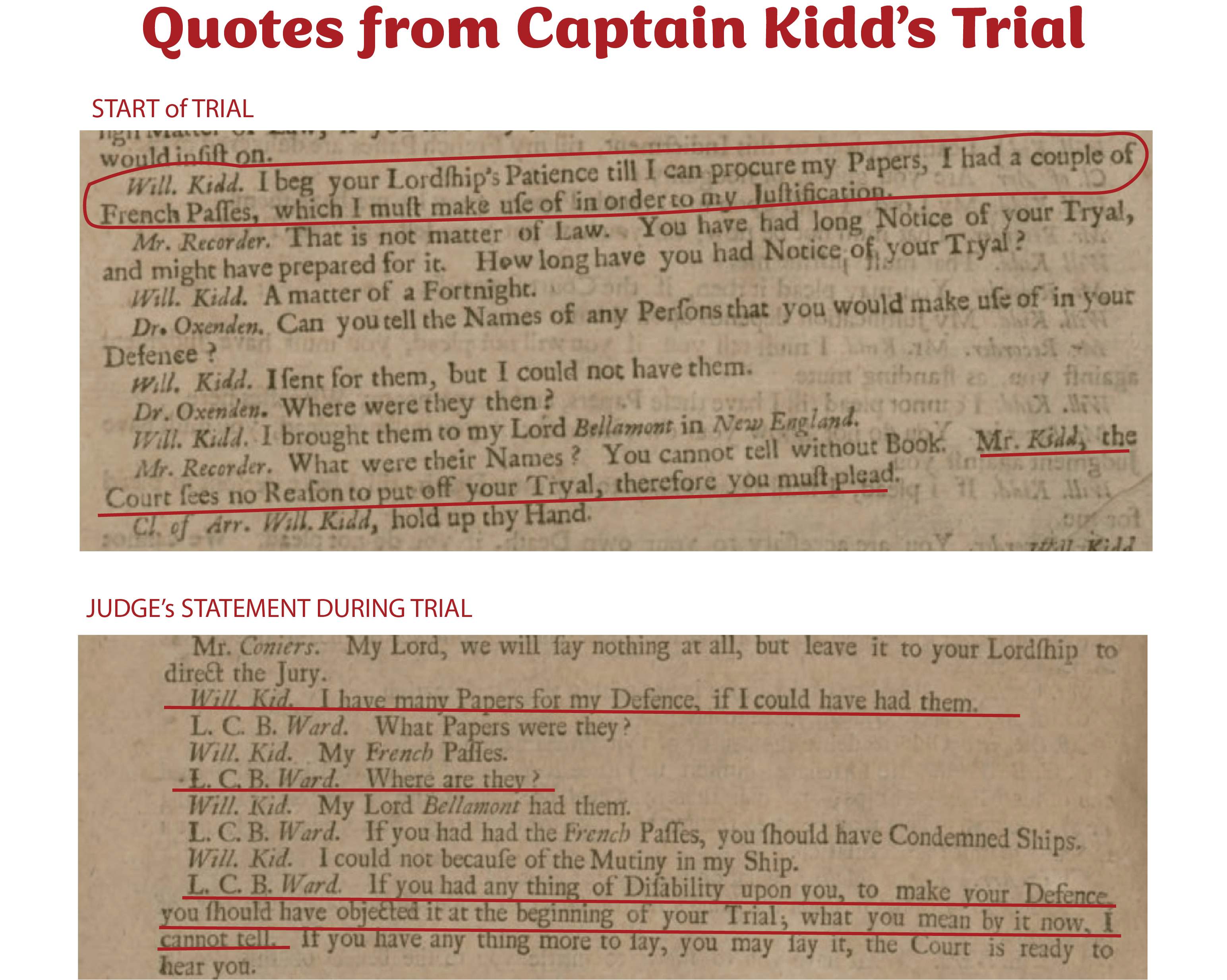
The court repeatedly refused his request for council, demanding he first make his plea. He stated that documents proving his innocence were taken from him. He was told “That is not a legal matter but a factual matter, and you cannot speak to your lawyer about a factual matter until you have pled.” (Source: His Majesty’s Commission, 1701. pages 3 and 4. See references below)
He pled not guilty.
His newly appointed lawyers finally spoke. Mr. Lemons and Mr. Oldish reiterated Kidd’s point - the missing papers were essential to his defense. The court answered, “Perhaps such documents would help with the charge of piracy, but not murder. Therefore, the murder trial can go forth without the documents.”
His legal council was apparently permitted to go search for the stated documents as they never spoke again. William was left to defend himself without council on the murder charge. Immediately after the murder trial, the piracy trial began - lawyers absent. He was alone against the nation’s most powerful lawyers.
2. Bogus Murder Charge: Assassination by Bucket

“That the aforesaid William Kidd, feloniosly, voluntarily, and of his Malice afore-thought did kill and murther the aforesaid William Moore upon the High Sea”
(His Majesty's Commission, 1701, page 5)
In addition to “malice afore-thought” they also stated it was unprovoked.
“My Lord and Gentlemen of the Jury, We will prove this as particularly as can be, that William Kidd was Captain of the Ship, and that William Moore was under him in the Ship, and that without any Provocation he gave him this Blow, whereof he died"
(His Majesty's Commission, 1701, page 13)
The testimony of Joseph Palmer
Moore was sharpening a chisel. Kidd passed Moore and stopped.
- Kidd: You claimed I could have attacked that Dutch ship and been in the clear. Just how could that have ever been legally cleared?
- Moore: Sir, I never said any such thing or even thought any such thing.
- Kidd: You are a lying, lousy dog.
- Moore: If I am a lousy dog, you have made me so; you have brought me and many others to ruin.
- Kidd: Have I ruined you, you Dog?
Following Palmer’s testimony, the Surgeon Bradinham agreed with Palmer’s account and stated Moore, who had previously been in good health, died the next day from the injury. Kidd’s witness contradicted him reporting that the sickly gunner died several days to a week after his injury.
Palmer and the surgeon maintained there was absolutely no mutiny on the ship. Meanwhile Kidd and his crew members insisted there had been calls for mutiny to attack non-French ships.
Is the modern reader left without clues to which of the long-gone witnesses lied? No, the inconsistency is right there in the testimony. According to Palmer, Moore stated he never even thought about attacking the Dutch ship. But then Moore said, “You have brought us to ruin.”
Kidd’s refusal to turn pirate was the cause of their financial hardship: the very thing they argued about.
Palmer and Bradinham specifically stated there was no mutiny on board. But it is a fact that these two abandoned Kidd to join Culliford the arch-pirate. That is mutiny - which they claimed was not onboard.
A dishonest court would have a reason to send Kidd’s newly engaged lawyers away.
3. Controlled: Court Prevented Kidd from Discussing Mutiny or Defending Himself
At this point Kidd attempted himself to show the inconsistency of their testimony by stating those witnesses were mutineers - as any lawyer would do. But the solicitor stopped him:“Even if they were mutineers, that didn’t give you the right to kill Moore.”
Kidd had a valid point: how could Bradinham deny mutiny when he himself had engaged in it?Kidd called three witnesses from his crew. They contradicted Palmer and Bradinham on several points. No one sought to clarify the contradictions. They simply assumed it was the accusers who told the truth.
As the beleagered captain began to contradict Palmer’s statement, he was stopped. “You may ask the witness questions,” he was told, “but you can’t make your own statements.” (His Majesty's Commission, 1701, page 11) )
Asked if he wished to call other witnesses or make an assertation, he declined, since all statements made by him were cut short; all statements made by his crew were brushed aside.
Now the prosecutor addresses the jury. A crime of passion, he explained, is manslaughter. But a premeditated attack is murder. He then then reiterated the accusations of malice, aforethought, without provocation.
Captain Kidd attempted to answer the charge but was forbidden to speak. His time was up. The prosecution could address the jury; defense could not. Prosecution could summarize his arguments; defense never got to make one. Not once was William Kidd allowed to tell what happened.
All jurors found him guilty of murder.
4. Dishonesty: Seized Documents Withheld
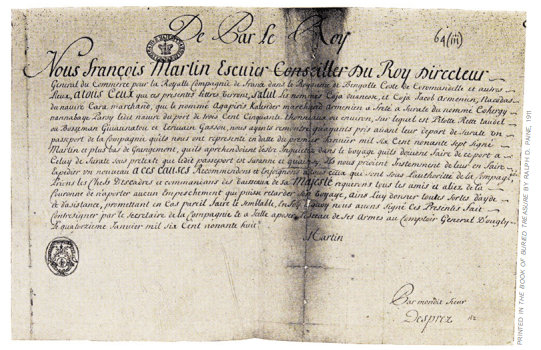
After the murder trial, immediately the court proceeded to try Kidd and nine former crew members of piracy. His lawyers remained absent. The fourth proof of corruption is that fact that his seized documents were missing - as he had stated at the outset.These missing papers included the French passes of the two ships he seized. Again, the instructions to the jury were correct: “If Kidd was right that the ship had a French pass, it was legal for him to take it. But if it did not have a French pass, it was an act of piracy.” (transliterated into modern English.)
Perhaps, even as these words were spoken, his lawyers were trying unsuccessfully to locate the papers. The prosecutor’s next words must have galled the captain:
Now what does Capt Kidd say to all this? He has told you he acted Pursuant to his Commission; but that cannot be unless he gives you satisfaction that the Ship and Goods belonged to the French King, or his Subjects, or that the ship had a French Pass, otherwise neither will excuse him from being a Pirate, for if he takes the Goods of Friends he is a Pirate, he had no authority of that : there is no color from either of his Commissions for him to take them. And as to the French Passes, there is nothing of that appears of any Proof, and for ought I can see, none saw them but himself, if there were ever any.
(His Majesty's Commission, 1701, page 34)
“If you had anything of Disability upon you to make your defense, you should have objected at the beginning of your trial. What you mean by it now, I cannot tell.”
(His Majesty's Commission, 1701, page 32)
The Missing French Pass
With sunlight shining on those French passes, the charge of piracy evaporates.
5. Misrepresentation: Goods Taken From the Ship
Some might contend that it was mere incompetence, not corruption, that accounted for the missing documents. Yet our fifth evidence of intentional corruption is the next set of indictments brought against the ten men. From page 41 to 57 of the trial, in great detail, Palmer and Bradinham testified of the goods sold and the shares distributed among the sailors. The indictment stated they “Piratically and Feloniously did Steal and Carry away:- Coffee, pepper, myrrh, Arriabian Gold - designated as worth 21 British pounds from Quedah Merchant
- Cotton, 2 horses, 50 quilts and 500 pounds of British money - valued at 585 pounds from the Moorish ship Roupelle/November
- Sugar candy, sugar, tobacco - total value 81 pounds also from Roupelle/November
- Money, opium, rice, beeswax, butter, iron - listed value 76 pounds also from Roupelle/November (His Majesty's Commission, 1701, page 35-38)
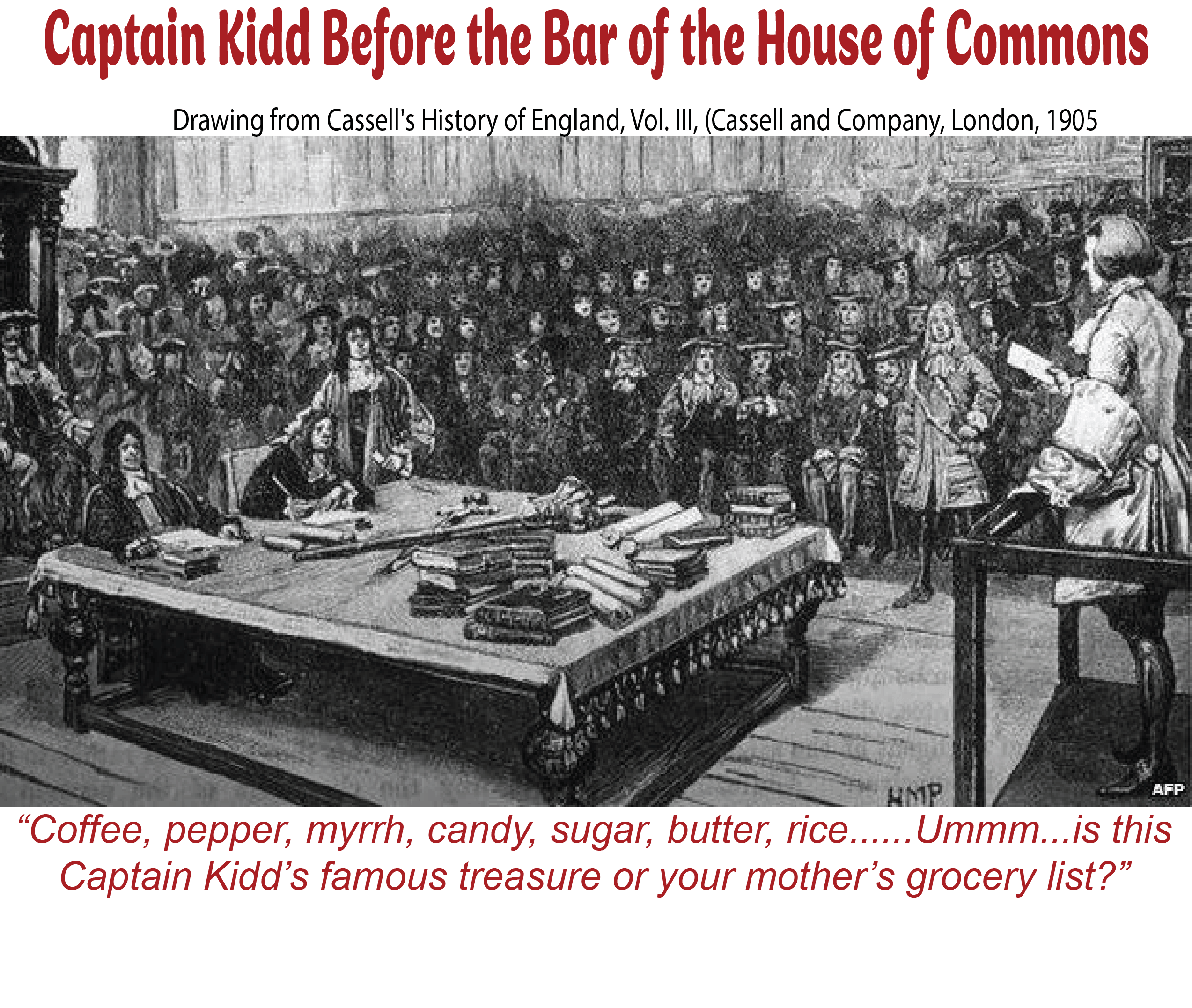
Kidd did try to explain that the mutineers had, by the time these goods were sold, seized control of the ship. Yet, as previously outlined, he was thwarted from discussing mutiny.
They were found guilty of piratically and feloniously stealing.
6. Fruit of a Poisoned Tree: No Valid Witnesses
In the twenty-two months from his arrest until Captain Kidd’s trial, the government could not come up with a single credible witness. If he had indeed been a “notorious pirate,” why could they not - in nearly two years - find a witness from a captain, a sailor, or a passenger that had been illegally waylaid?The only two witnesses for all indictments were Joseph Palmer and Surgeon Bradinham - both pirates. Kidd’s servant Barlicorn testified that the surgeon was “as foreward as anyone” in urging piracy. (His Majesty's Commission, 1701, page 11)
William Kidd asked Bradinham, “Did you save your own skin by agreeing to lie in order to take mine.” The prosecutor wouldn’t allow him to answer.
The inability to secure any real witnesses and the use of known pirates constitutes the sixth evidence of corruption.
7. Gaslighting: Declared Guilty Before The Trial
The overwhelming act of gaslighting on the part of the government is the seventh proof of corruption. For the last three centuries, the name “Kidd” and “notorious” are tightly bound. At the time of his arrest, all of England was against him.When his ship docked in the Carribean, the crew first learned Kidd was declared a pirate. They saw posters offering pardons to any who turned themself in EXCEPT William Kidd and Henry Avery. Avery was considered “the king of pirates” whose crimes initiated “the golden era of piracy.” He had disappeared years before. By equating Kidd with Avery, his guilt was announced before his trial.
Ask anyone if they ever heard of Captain Kidd and they will undoubtedly agree he was one of the most villanous of all pirates. Then ask them what he had done. He threw a bucket at a mutineer? He took two ships which he was hired to attack - though the proof had mysteriously disappeared? His mutinous crew left him?
If he was a pirate, he was the most unsuccesful one in history.
8. Injustice: The Real Pirates Were Pardoned
The final piece of evidence that they decided to eliminate him via a rigged trial is demonstrated by the comparison of Kidd with Culliford. Robert Culliford was the more dangerous pirate. He captured dozens of ships, razed towns, and murdered and raped villagers. He, too, was captured and tried. At his trial the same month he, too, was found guilty.So if William Kidd was hung, what should have happened to the fiercer, more violent buccaneer?
He was pardoned in a plea-deal to help bring another pirate to justice: Samuel Burgess. The arch-pirate testified against the arch-arch pirate.
So what happend to Burgess? He also was pardoned. Burgess went on to become a slave trader. Culliford sailed into the west - free and forgotten.
Culliford 4: Kidd 0.
Refution
The unforgiving public has been reluctant to let Captain Kidd off the hook. Pirate lore is a popular commodity, particularly with a treasure chest beneath it. Hence the critics of Captain Kidd point to four facts to try to maintain his legacy of notoriety.- William Kidd associated with pirates.
- He buried gold and valuables to hide his guilt.
- Accusations against him were widespread.
- Three of his crew members pleaded guilty.
Pirate Associate
Because Kidd had associated with pirates, some claim, he must have been a guilty pirate himself. Indeed, he won his original fame and fortune due to his privateering venture in the West Indies: an area swarming with pirates. His knowledge of their methods was what incited the financiers to choose Kidd in the first place. And while no one has yet proved he ever willingly took part in a pirate-attack, there are several known incidents where he refused to do so.If he was a pirate, he was certainly a reluctant one.
Buried Treasure
“But,” the critics will argue, “what about fact that he buried the treasure? Surely that proves his guilt.”As a matter of historical record, pirates did NOT bury treasure. John Gardiner turned over Kidd’s chest to government officials who sent it to England. Robert Stevenson picked up on the theme when he wrote Treasure Island, forever creating an association between pirates and buried treasure - and connecting Captain Kidd.
So why would William Kidd leave gold and valuables on the property of John Gardiner?
Very simple: he didn’t trust Governor Bellomont. He had been suspicious of him before he ever set sail.
Prior to the start of the journey, as the legal details of this venture emerged, Kidd had become apprehensive. As with all privateer ventures, the navy and king would share proceeds and the crew and captain would get their cut. But the pirate hunting aspect was different: Bellomont and his anonymous partners were to get an astounding 75% commission. The men who risked their lives at sea would get no salary and share the remaining 25%.
In the trial, Colonel Hewson testified that Kidd had complained before the voyage that Bellomont had threatened to take his ship and prevent him from leaving if he backed out.
“When he went this voyage, he consulted me and told me they had engaged him on such an expedition. And I told him he had enough (ie money) already, and might be contented with what he had. And he said that was his own inclination; but my Lord Bellamont had told him, if he did not go this voyage, that there were great men and they would stop his brigantine in the river, if he did not go.”
(His Majesty's Commission, 1701, page 47)
William Kidd’s wariness was correct. It was Bellomont who had him arrested in spite of offering him clemency. It was Bellomont who seized the documents that proved his innocence. Bellomont even imprisoned Mrs. Kidd and took away her entire estate, though she had no part in the venture, and owned her estate before she married William.
It was Bellomont who begged the British government to give him a share of the goods he unwillingly sent with his prisoner to England. Bellomont, desperate for a piece of a rapidly shrinking pie, started the legacy of missing treasure.
Bellomont, as a whole, was a failure of a govenor. His only successful act was having William Kidd arrested. Kidd was right to think that - even if he had not been arrested - Bellomont would have arranged to take all of the goods and deprive him and his crew of any reward for their years of labor.
In spite of his suspicion, Kidd was eager to clear his reputation, choosing to face the governor and rejecting the crew's desire to flee.
If he was a pirate, he was a very naive one.
Widespread Suspicion Throughout the Empire
Another justification for Kidd’s guilt is the fact that the entire British empire was against him. How could that many people be wrong?Since the time Commodore Warren sent out the bulletin that Kidd had decided to turn pirate off the coast of Africa, all of history agreed.
In 1724 Charles Johnson, an early pirate historian, stated Kidd made the decision to turn pirate as he rounded the Cape of Good Hope. (Source: Johnson, 1724. Page 65-80) That timing was based on Warren’s claims - not on Kidd’s.
In his 1834 History of Buccaneers, John Abbott wrote:
Captain Kidd had probably, in his silent thoughts, decided to turn freebooter. Though as yet he had divulged his secret to no one, and had committed no overt act, he had passed the Rubicon, and was in heart a pirate."
(Source: Abbott, 1874, page 42)
With the French passes still missing, he declared this about Kidd’s seizure of the Quedah Merchant:
"Kidd received them in his cabin, and upon inquiry ascertained that the ship and cargo belonged to Mongol merchants; that they had intrusted the command to a Dutch captain, as was not unfrequently the case in those days, and that the French gentleman was merely a passenger accidently on board, passing from one port to another.
"These tidings, to use a sailor’s phrase, “struck him all aback.” Holland, as we have mentioned, was England’s ally. The Great Mogul was England’s friend. Kidd must release the ship, or confess himself a pirate and an outlaw, and run the imminent risk of being hanged should he ever return to England. For a moment he seemed lost in thought, bewildered. Then his wicked mind, now rapidly descending into the abyss of sin and shame, rested in a decisive resolve. (Abbott, 1874, page 50)
But which contemporaries were against him?
- The navy despised the arrogance of the colonial upstart who would not bow to them.
- The East India Company felt threatened by the king’s commission in an ocean they thought belonged to them.
- The Indian merchants who had no use for European wars were not at all pacified that the captured ships bore French passes.

- Sir John Somers: Lord Chancellor and Keeper of the Great Seal
- Admiral Edward Russell: First Lord of Admirality
- The Duke of Shrewsbury, Charles Talbot: Secretary of State
- The Earl of Romney, Henry Sidney: Master General of Ordnance
- And finally: King William. (Dalton, 1911, pg 30)
In fact, herein lies another proof of his innocence. The Tory party was waiting for him to implicate the king and his Whig court. All Kidd had to do was state that the Whigs had told him to steal other ships and they would offer him a pardon. (Gray, 1933, page 206) But Kidd wouldn’t do it: even as the noose was slipped around his neck, he denied piracy.
If he was a pirate, he was a principled one.
Three sailors pled guilty
The final dispute against Kidd’s innocence is the fact that three of the nine mariners tried with him had pled guilty and claimed the right of a pardon. They responded to the king’s December 8, 1698 offer of a pardon to all pirates who would turn themselves in to Commodore Warren before July 31, 1699. They expected they would get more leniency if they surrendered and declared themselves guilty.Hence, these three pled guilty and requested the pardon. Even then the trial solicitor would not acquit them - stating the pardon didn’t mean they couldn’t be tried - merely that the punishment should not be meted out if they qualified for the terms offered.
Then, in another shady act, he declared the three men were not qualified for the pardon because they had not submitted themselves to any of the four officials named in the offer. These were Commodore Thomas Warren, Israel Hayes, Peter Dallanoye and Christopher Pollard, most of them at sea. This is equivalent to someone turning themselves over to the local police because there is no FBI office in their town.
They were found guilty.
In fact this strengthens the proof of corruption: the officials respected neither the pardon they had offered or a reduced sentence in exchange for a guilty plea. For years to come pirates ignored offers of pardons due to the court’s response to Kidd’s crew. (Gray, 1933, page 207)
But, just for the sake of argument, let’s agree with the mind-reading critics. Imagine the French passes didn’t exist and Captain Kidd seized two unauthorized ships. He displayed his commission knowing it was invalid - like a bank robber flashing his driver’s license - and then released everyone unharmed.
If he was a pirate, he was a dumb one.
Peroratio
He stood at his trial and at his execution the man he always been: a seaman, a Scottsman, a colonial - a mere commoner against powerful men who used him in a secret plan to enrich themselves. His written statement and verbal explanations remained consistent with the facts. Bellomont's statements did not.Imagine today if a government created an anti-theft division. They confiscated all stolen goods, sold them, and distributed the profits to themselves. That was the plan of Bellomont and the anonymous other lords.
Some say Kidd was unlucky. To say he was unwise is perhaps more accurate.
Privateering was an all around bad business: no purchase/no pay, perpetual wars, conscription, a powerful corporation struggling to maintain control, a ruling class that disdained commoners, and the ever-present stench of human slavery. Kidd’s instincts told him to bail as details emerged; Bellomont’s threats prevented him from doing so.
He should have listened to his instincts. He lost the Antigua anyway - and so much more. He did not fear death, he said, but he hated the dishonor to his reputation which he valued highly.
If he was a pirate, he was an honorable one.
Sources
Sources are for all pages. We do not use live links as changes interfere with the site; but copy and paste either the URL or the title to find online copies of original documents.
Abbott, John S.C. 1874. Captain William Kidd and Others of the Buccaneers. Dodd & Mead, NY.https://www.gutenberg.org/cache/epub/50550/pg50550-images.html
Accessed 9/17/2026
Dalton, Sir Cornelius Neale. 1911. The real Captain Kidd: A vindication. William William Heinemann publisher, London.
https://www.gutenberg.org/files/54444/54444-h/54444-h.htm
Accessed 9/12/26
Gray, Charles. 1933. Pirates Of The Eastern Seas (1618-1723), A Lurid Page of History. Sampson Low, Marston & Co., Ltd. Chapter X, Captain William Kidd in the Adventure Galley and the Qyedah Merchant pg 186-209.
https://archive.org/details/PiratesOfTheEasternSeasCharlesGrey
Accessed 9/16/26
Henry, William (also called King Henry III of England, Henry the Orange). 1695. English Letter of Marque Against Pirates.
https://constitution.org/1-Activism/mil/lmr/1695engl.htm.
Accessed 9/16/26
His Majesty’s Commission. 1701. The arraignment, tryal, and condemnation of Captain William Kidd, for murther and piracy, upon six several indictments, at the Admiralty-Sessions, held by His Majesty’s commission at the Old-Baily, on Thursday the 8th. and Friday the 9th. of May, 1701
https://www.loc.gov/resource/law.00302205929
Accessed 9/12/2026
Johnson, Charles. 1724. A General History of the Pyrates: From the First Rise and Settlement in the Island of Providence, to the present time. Volume Two T.Warner: London. Chapter 3: Of William Kidd, pg 65-80
VOLUME TWO https://www.gutenberg.org/cache/epub/57005/pg57005-images.html
Accessed 9/16/26
Kidd, William. 1699. A Copy of a Narrative of the Voyage of Captain William Kidd, Commander of the “Adventure Galley,” from London to the East Indies. Quoted in Dalton, 1911, Appendix B page 255
Luttrell, Narcissus. 1856. Brief Historical Relation of State Affairs. Volume 2, 1690 - 1692
Extracts quoted by Dalton, 1911, page 325
Marquis, Samuel. 2025, August. Captain Kidd & the Trial of the Century: A 325-Year Stain on the British Crown. Sea History 192, pages 30-36.
https://seahistory.org/wp-content/uploads/SH192-Capt-Kidd.pdf
Accessed 9/10/26.
Zacks, Richard. 2002. Pirate Hunter: the true story of Captain Kidd. Hyperion Books


Ready To Use Resources