
Captain Kidd: The True Story
The true story of Captain Kidd demonstrates the difference between fact and fiction.
Was he a villain? A victim? Both or neither?
Exordium
The notorious pirate stood before a ruthless crowd calling for his much-deserved execution. But wait! Was Captain Kidd really a villain? New light shed on old documents indicates he was not the murderous cut-throat history claimed. Sometimes history gets it wrong.And sometimes history outright lies. Evidence shows not that Kidd was guilty, but the men that accused and tried him were.
Narration
Carribean Privateer
It was a time when pirates hunted merchant ships carrying exotic goods from foreign ports. Men in wigs looked down their powdered noses at the masses while engaged in countless wars. The Whigs tried to tamper the growing power of the East India Company supported by the Tories.William Kidd first sails into this drama as the lone Scottish sailor in the midst of seven British and 110 French seaman onboard the Sainte Rose - a privateer. Privateering, you may recall, was a legal enterprise granting a private captain the ability to capture any merchant ship registered to a declared enemy nation. As with all privateering ventures, the captain and his crew got a slice of the proceeds and the Admirality - or navy - got the rest. Win-win! (Unless, of course, you happened to be the captain or owner of the captured ship.)
In this particular case the Sainte Rose was targeting Dutch ships in the Carribean. But mid-journey the French war with the Dutch ended and the Nine Year War between France and England began - leaving the English sailors in a rather precarious station. When Sainte Rose docked to attack a British port, William Kidd acted. As the majority of the sailors rowed to land leaving the handful of British sailors and a few French onboard, Kidd led a daring counter-attack, threw the few French sailors overboard, cut the cables, and sailed the ship to the English. That was considered valiant and William Kidd declared a hero.
Over the next year that ship, renamed the Blessed William, proved strategic for the British cause in the Carribean under Kidd’s command. One of the British sailors, Richard Culliford, encouraged the now Captain Kidd to engage in a little piracy - a rampant practice among the West Indies at the time. Kidd refused. With Kidd on shore, in an act reminiscent of the one he had assisted in the year before, Culliford cut the ropes and stole the ship. That was considered mutiny.
Mutiny, or deposing a sea captain, was regarded as a nefarious crime. Mutineers were executed. But Culliford was more than a mutineer. He became one of the most lethal pirates of his time. With the Blessed William under his command, the score in this personal and global conflict was Culliford 1: Kidd 0.
In spite of losing the ship, Kidd was still regarded a hero, given the ship Antigua, and rewarded 150 pounds. (The average salary was 10 to 20 pounds a year.) He sailed the Antigua to New York City, his home port.
His fortunes further improved the next year when he married the wealthiest widow in New York State - a Mrs. Sarah Oort, who just so happened to be young, rich, and very well placed. Times were good.
Planning Captain Kidd's Venture
The roots of Kidd’s villanous legacy began a few years later in 1695 while seeking a commission as a British naval officer. There in London he was approached to take part in a new venture by Robert Livingston, a wealthy New York colonist, and the Lord Bellomont.As a reward for helping secure the throne for William III, Bellomont had recently obtained the position as governor of New York, Massachussetts, and New Hampshire. Governor of one colony was prestigious - of three a powerful position indeed. Bellomont’s plan was backed by four other Whigs who wished to remain anonymous.

our trusty and well-beloved Capt William Kidd
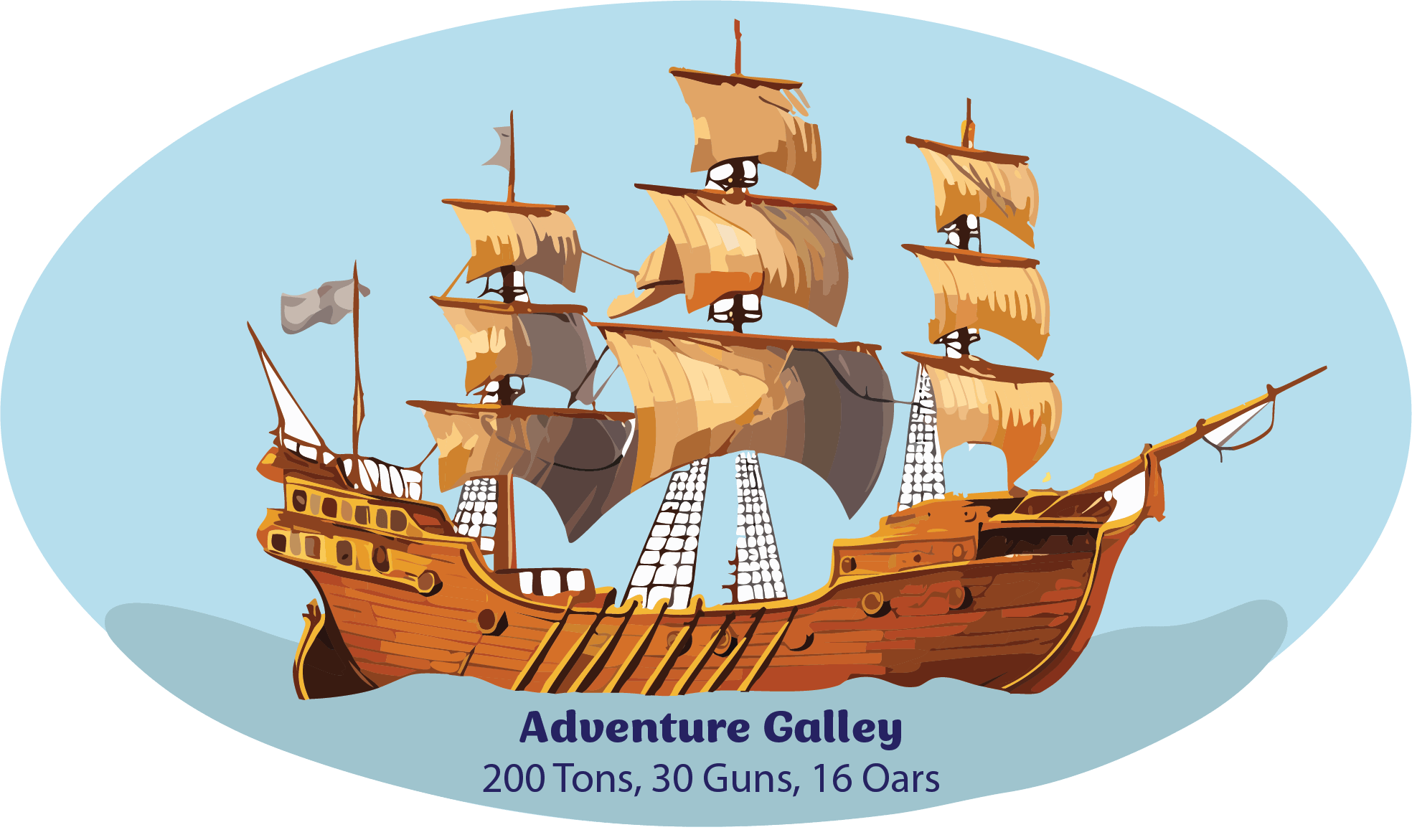
Based on his experience in the Carribbean, Kidd recommended that their new ship be built with 16 oars, allowing them to row when others were becalmed. The financial backers complied and the Adventure Galley was quickly built and outfitted for the journey to New York - its designated home port.

Heading Eastward
September 1696 the Adventure Galley set sail from New York enroute to the Indian Ocean on its truly adventurous two-and-a-half year voyage - a voyage Kidd would finish with only thirteen of his original 152 crew members - and without the ship.After heading back across the Atlantic and down the western coast of Africa, an event that proved beneficial to the crew, but deadly to Kidd, occurred. They met up with Commodore Thomas Warren of the British Navy who had endured multiple misfortunes. He wanted to conscript men from the Adventure Galley. Conditions in the Navy were dreadful. That night, while all slept, the Adventure Galley’s oars rowed them away from the commodore’s reach.
Warren was furious when he realized the ship - and his extra crew members - were gone. He stated Kidd had turned pirate. He produced no evidence but Warren was connected to the East India Company so his news was distributed to every port.
The first fourteen months brought no prizes - which was the official word for the ships they captured. The crew became anxious. Remember, no prizes, no pay. The crew urged Kidd to attack other ships, which he refused to do. Desperation grew. Mutiny was in the air.
On October 30, 1697, the gunner William Moore and Kidd got into an argument about Kidd’s refusal to attack a Dutch ship, one clearly outside of their commission. A conflict arose between captain and gunner and Kidd threw a wooden bucket, hitting the gunner’s head. Moore died later.
Prizes in the East Indies
Fourteen months after setting sail, Kidd and company finally caught a prize near Calicut, the Rouparelle, a ship sailing with a French pass.But their long awaited opportunity arose two months later. On the last day of January 1698 the crew of the Adventure Galley spotted the Quedah Merchant - an Armenian ship. And what a prize: 70,000 pounds in goods! Some sources say its worth was only 30,000 pounds, which at a minimum was worth a cool 30 million today.
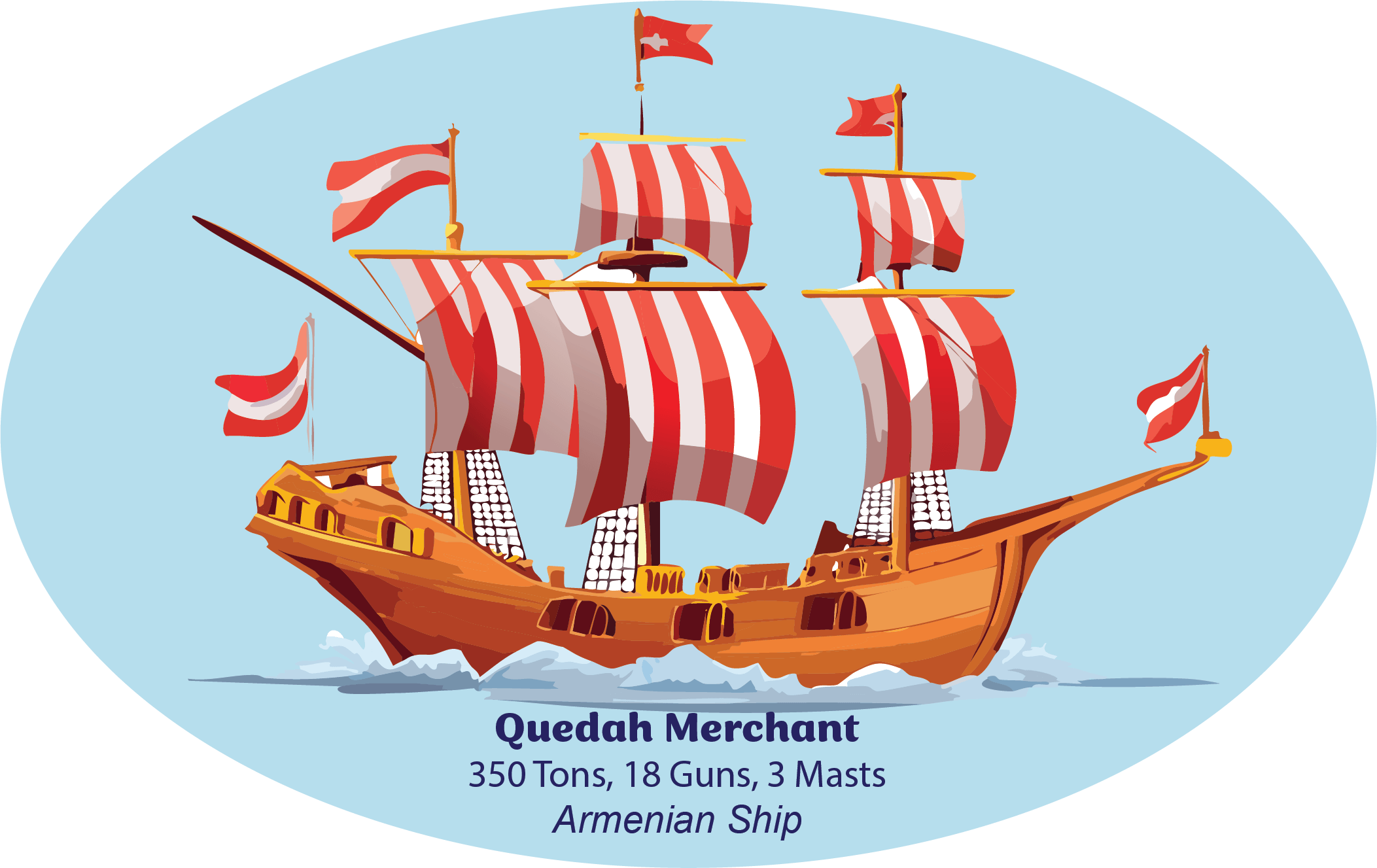
The original Quedah Merchant crew landed carrying the astounding news that their ship was seized by a Captain Kidd with a commission signed by the English king himself.
At Madagascar
Heading back towards home with its two prizes, the Adventure Galley stopped at St Mary’s, an island off of Madagascar. Already docked was a ship commanded by the same Robert Culliford that had taken his ship in the West Indies. By now Culliford was an arch pirate whose villainy included attacking ships of all nations. Unfortunately for Kidd, most of his adventure-starved crew elected to abandon him and join Culliford. Captain Kidd now had three ships and only a handful of men to sail them.Culliford 2: Kidd 0.
The hastily built Adventure Galley was worm-eaten so he sunk it and the Rouparelle. The small crew of Kidd’s loyal sailors transferred what valuables their former shipmates didn’t confiscate to the Quedah Merchant, now renamed the Adventure Prize.
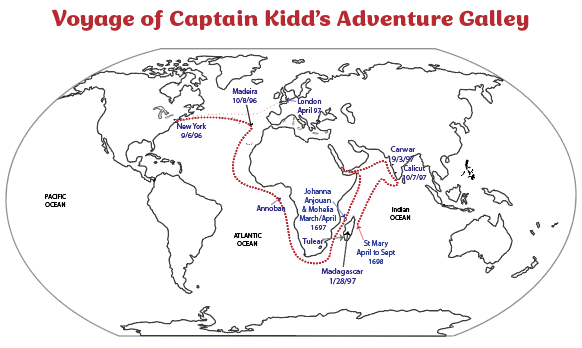
Officials in India were furious, blaming the loss of both the Quedah Merchant and the Great Mohammed on William Kidd and the commission he had displayed. The government of India banned trade with England and imprisoned employees of the powerful East India Company. In response, England issued an order to all ports to seize Captain Kidd.
Culliford 3: Kidd 0.
West Indies to New England
The Adventure Prize arrived in the West Indies in March 1699 on its way back to New York. Kidd discovered the Nine Year War had ended in January of that year and Kidd himself had been labeled a pirate. The pirate hunter had become the prey!
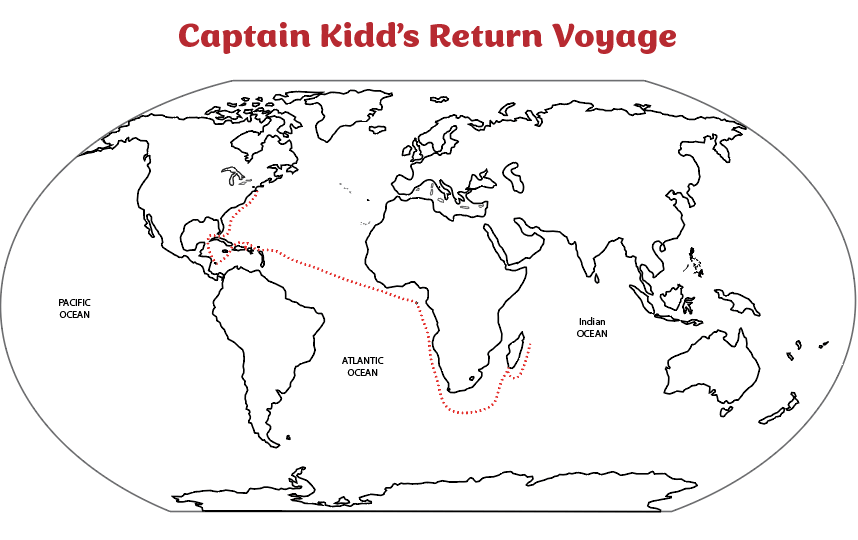
Kidd's End
His adventure days coming to an end, Kidd was arrested in Boston in July 1699 and held in prison for six months having had all his documents and goods seized. He arrived in England April 1700. For an additional fourteen months he rotted in prison without being charged for any crimes. The lords who backed the venture were nowhere to be found.May 8, 1701 a brief trial was held. He represented himself. The documents seized by Lord Bellomont were gone. And to his surprise he found he was charged not just with piracy but also for the murder of the gunner William Moore. He was found guilty and sentenced to execution.
Fifteen days later he was publicly hung. Strangely, the rope broke and he fell - unhurt - into the mud. In that era that would usually allow the prisoner to go free - but not for Kidd. He was hauled back up, muddy and humiliated, and hung for a second time. Justice had been served.
Except - it wasn’t.
Propositio
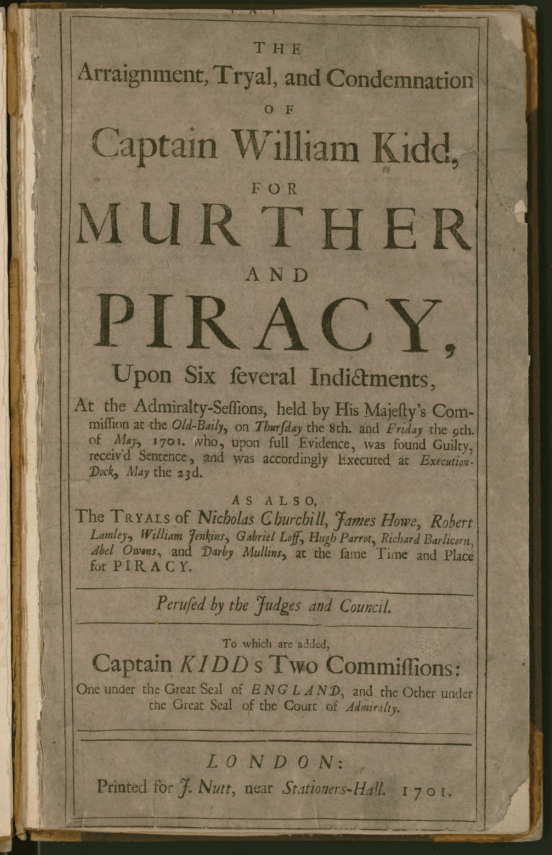
The court’s own record demonstrates eight elements of corruption that would invalidate any sentence against Captain Kidd.
- They denied Kidd legal counsel.
- They indicted on a bogus murder charge.
- They prevented him from disclosing to the jury the fact his ship had been mutinied.
- They hid the evidence proving his innocence.
- They misrepresented the charge of selling goods.
- They could not produce one valid witness.
- They pardoned dangerous pirates while executing a non-violent privateer.
- The government had declared Kidd’s guilt to the public before his trial began.
Part II: Was Captain Kidd Guilty?
Sources
Sources are for all pages. We do not use live links as changes interfere with the site; but copy and paste either the URL or the title to find online copies of original documents.
Abbott, John S.C. 1874. Captain William Kidd and Others of the Buccaneers. Dodd & Mead, NY.https://www.gutenberg.org/cache/epub/50550/pg50550-images.html
Accessed 9/17/2026
Dalton, Sir Cornelius Neale. 1911. The real Captain Kidd: A vindication. William William Heinemann publisher, London.
https://www.gutenberg.org/files/54444/54444-h/54444-h.htm
Accessed 9/12/26
Gray, Charles. 1933. Pirates Of The Eastern Seas (1618-1723), A Lurid Page of History. Sampson Low, Marston & Co., Ltd. Chapter X, Captain William Kidd in the Adventure Galley and the Qyedah Merchant pg 186-209.
https://archive.org/details/PiratesOfTheEasternSeasCharlesGrey
Accessed 9/16/26
Henry, William (also called King Henry III of England, Henry the Orange). 1695. English Letter of Marque Against Pirates.
https://constitution.org/1-Activism/mil/lmr/1695engl.htm.
Accessed 9/16/26
His Majesty’s Commission. 1701. The arraignment, tryal, and condemnation of Captain William Kidd, for murther and piracy, upon six several indictments, at the Admiralty-Sessions, held by His Majesty’s commission at the Old-Baily, on Thursday the 8th. and Friday the 9th. of May, 1701
https://www.loc.gov/resource/law.00302205929
Accessed 9/12/2026
Johnson, Charles. 1724. A General History of the Pyrates: From the First Rise and Settlement in the Island of Providence, to the present time. Volume Two T.Warner: London. Chapter 3: Of William Kidd, pg 65-80
VOLUME TWO https://www.gutenberg.org/cache/epub/57005/pg57005-images.html
Accessed 9/16/26
Kidd, William. 1699. A Copy of a Narrative of the Voyage of Captain William Kidd, Commander of the “Adventure Galley,” from London to the East Indies. Quoted in Dalton, 1911, Appendix B page 255
Luttrell, Narcissus. 1856. Brief Historical Relation of State Affairs. Volume 2, 1690 - 1692
Extracts quoted by Dalton, 1911, page 325
Marquis, Samuel. 2025, August. Captain Kidd & the Trial of the Century: A 325-Year Stain on the British Crown. Sea History 192, pages 30-36.
https://seahistory.org/wp-content/uploads/SH192-Capt-Kidd.pdf
Accessed 9/10/26.
Zacks, Richard. 2002. Pirate Hunter: the true story of Captain Kidd. Hyperion Books


Ready To Use Resources