
Scientific Classification Worksheet
Use the scientific classification worksheet from MatchCard Science to learn how we find genus and species for all living organisms.
Free Download Below

The Scientific Classification MatchCard
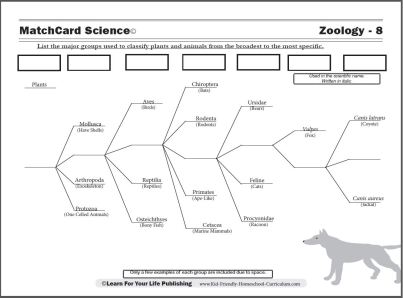
Objective: List the major groups used to classify plants and animals from the broadest to the most specific.MatchCard: Download below.
Students will list the following groups in correct order across the top of their page:
- Kingdom
- Phylum
- Class
- Order
- Family
- Genus
- Species
Oops! Were you looking for domain at the top? Our different scientific classification systems lesson explains how "domain" has been added to the top of the taxonomy charts. But this lesson is for elementary students, so we start with the earlier (and simpler) system - as devised by Carl Linnaeus himself.
Print the Scientific Classification MatchCard
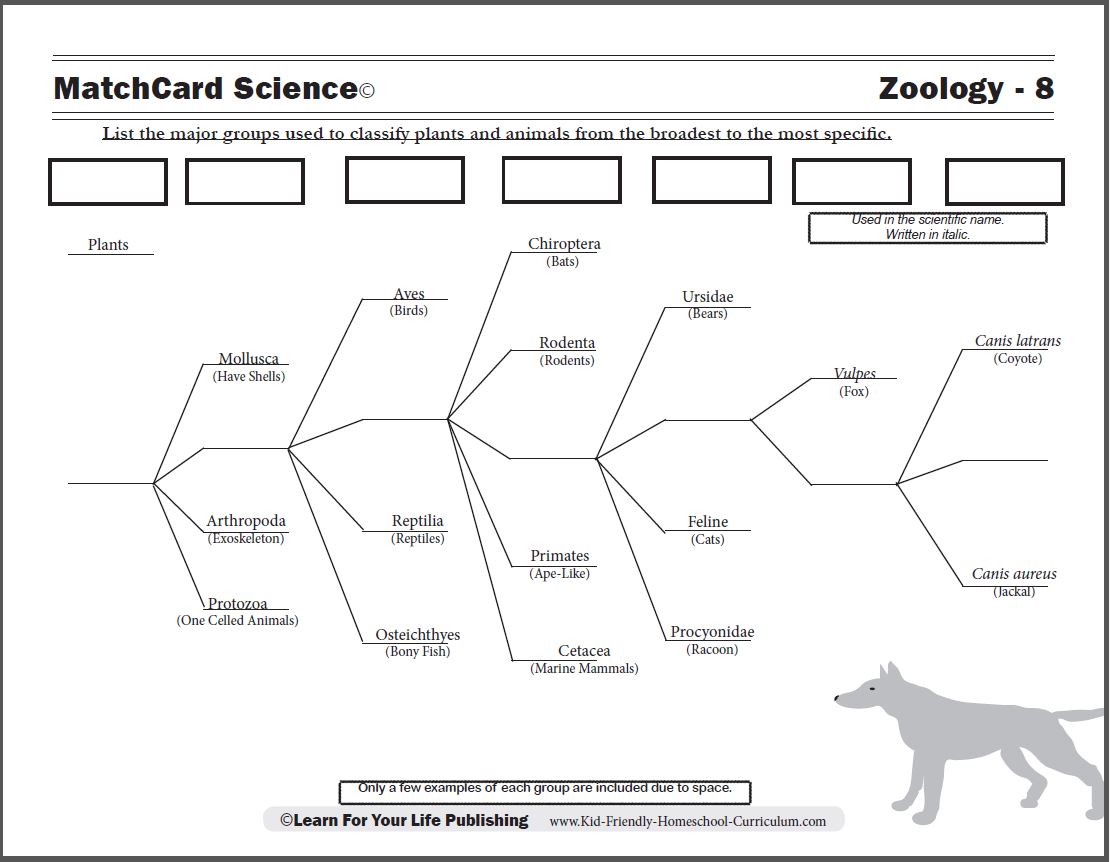

Click image to go to download.
This is MatchCard #8 of the Zoology Unit Study. Find more information on MatchCard Science below.
Introducing the Classification System
Explain that the classification system was developed to group all living creatures. The system we have today is based on the work of Carl Linnaeus, a contemporary of Benjamin Franklin and George Washington in the eighteenth century. (That little historical fact keeps getting mentioned for a good reason.)Kingdom, Phylum, Class
Have these words spelled out on a board to show your students:- Kingdom
- Phylum
- Class
- Order
- Family
- Genus
- Species
Kingdoms: How Many?
We are going to learn how this sytem works by learning the scientific classification of dogs.To start with, Linnaeus came up with two broad groups of living organisms. Can you guess what they would be. (Let them guess. Linnaeus had the two groups: Plants and Animals.)
Many modern textbooks list six different kingdoms: Animalia, Plantae, Fungi, Bacteria, Protista, Archaea. Others may list five. (See our scientific classification systems, linked to above and below.)
Discussion: Why did Linnaeus miss several kingdoms? Why are there differences of opinion?
To make it simple, we are going to focus on the plant and animal kingdom for now. Later you will learn about the microscopic organisms and how they share some characteristics with plants and animals yet have unique characteristics that require a separate kingdom.
But right now, we are going to get a basic idea of how the scientific classification system works by finding out how dogs are classified.
Phylum
A phylum is a subdivision of a kindgom. Again, we will find out that the original system designed by Linnaeus was not completely accurate, and there is disagreement among modern scientists as to the exact number of phyla in the animal kingdom. Later we will learn about ten animal phyla.But there are two animal phyla that we are most familiar with:
Arthropoda: Exoskeleton
Chordota: Endoskeleton with spinal cord and vertebra
For fun: Can you think of any other animals that don't have an endoskeleton or exoskeleton? We'll learn about them in a future lesson.
So what is a dog: an arthropoda or a chordota? Obviously, it is a chordota.
So let's make our chart list the scientific classification of dogs. So far, it should look like this:
- Kingdom: Animal
- Phylum: Chordota
- Class:
- Order:
- Family:
- Genus:
- Species:
Class
A class is a sub-division of phyla. Brainstorm what groups of animals they can think of with spinal cords and backbones. They may come up with a list such as:- Bats
- Rodents
- Birds
- Fish
- Mammals
Uh, Oh
Unfortunately, as accurate as Linnaeus was, it turned out there were some gaps in his sytem. For instance, modern scientists break the class into "sub-classes". Subclasses of mammals include those with placentas and those without. We will stick to the system as Linnaeus developed it. But as you study some of the less known creatures, it becomes harder to use his original system so subdivisions had to be developed.Order
There are different orders of mammals, but dogs are in the order "carnivora." A carnivore is a meat-eater.At this point, show MatchCard #8, the student copy. Use a sheet of paper to cover up the classes not yet discussed. Let them put the pieces for the first few groups on.
They can read some of the orders of mammals including bats, primates, and marine animals. They should put the "carnivora" in the correct space on the worksheet.
- Kingdom: Animal
- Phylum: Chordota
- Class: Mammalia
- Order: Carnivora
- Family:
- Genus:
- Species:
Family
How many families can you brainstorm from the carnivora order? Let them think of several before showing them the other families on the worksheet.The canidae family includes all the dog-like animals. The word caninine comes from this. Introduce the students to the words "canine" (dog) and "feline" (cat) if they are not already familiar with them.
Can you think of many animals that are "dog-like" besides dogs? (Answers: wolves, foxes, coyotes, jackals)
- Kingdom: Animal
- Phylum: Chordota
- Class: Mammalia
- Order: Carnivora
- Family: Canidae
- Genus:
- Species:
The canidae family includes dogs and foxes which we will learn about below. The canidae family also includes jackals and coyotes - who are in a different genus than the dogs/foxes.)
Genus
The canidae family includes the commonly known genus known as "canis." That word "canine" is easiy detected in the term "canis." Dogs and foxes are in the canis genus. Notice that the name of a genus is printed in italics. It is part of the scientific name.- Kingdom: Animal
- Phylum: Chordota
- Class: Mammalia
- Order: Carnivora
- Family: Canidae
- Genus: Canis
- Species:
Species
The species is the last part of the scientific classification. For dogs, the specific species is "Lupis".Whenever giving the scientific name of an organism, you give the genus AND species, and write it italic.
- Kingdom: Animal
- Phylum: Chordota
- Class: Mammalia
- Order: Carnivora
- Family: Canidae
- Genus: Canis
- Species: Lupis
Uh, Oh
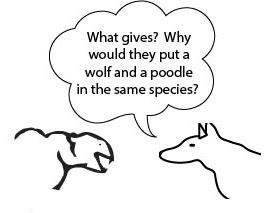
Is that it?What happened to terriers that are broken into Scottish Terriers and Boston Terriers and other breeds of dogs?
Neumonic: King Phillip
For years students have remembered the classes with this neumonic:King Phillip cried, "Oh For Goodness Sake."
Teach them that, and they are likely to remember the order for the rest of their life.But just for fun, take off all the Information Pieces on the MatchCard, scramble them up, and see if they can arrange the groups on the top of the sheet.
Advanced Taxonomy: Scientific Classification Today
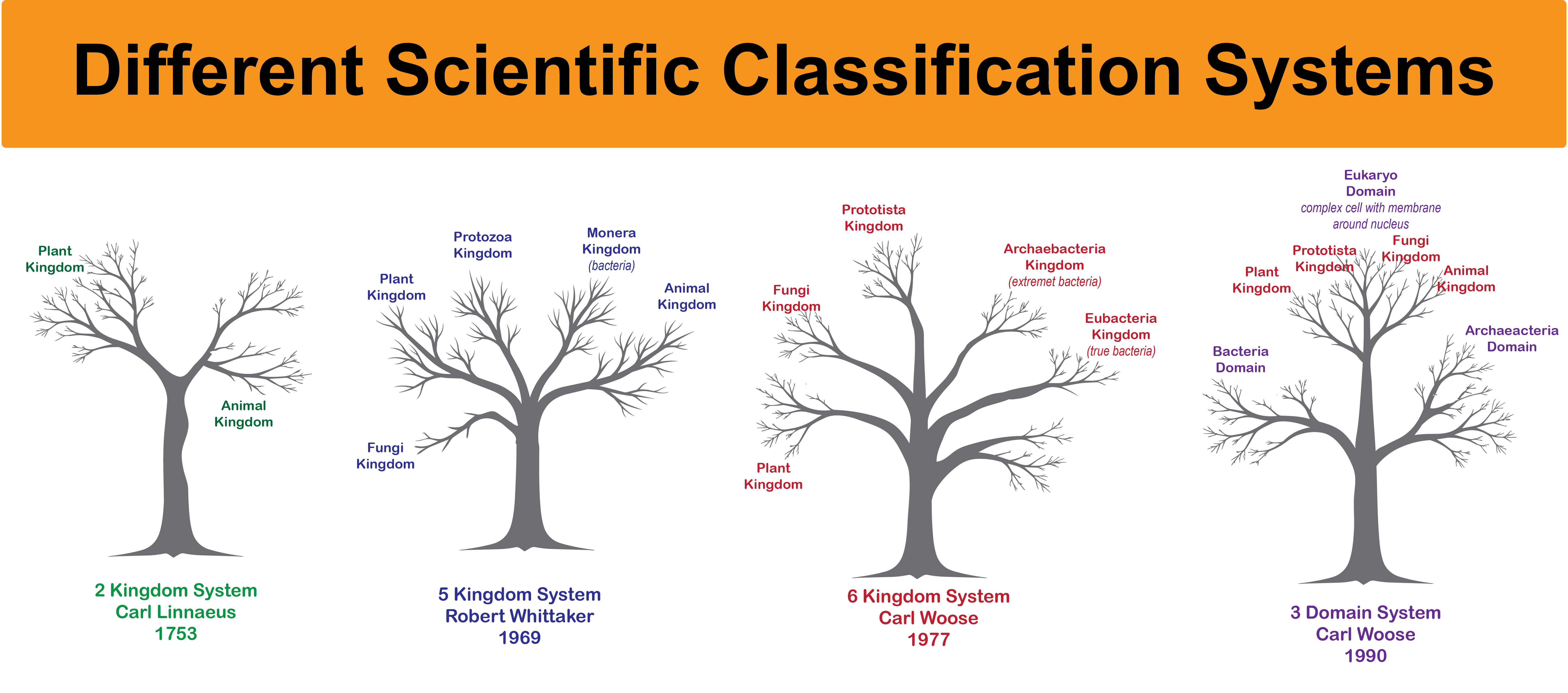
Older students learn four changes to scientific classification which explains our ever-increasingly complicated taxonomy chart.
Another Scientific Classification Activity: The American Bald Eagle
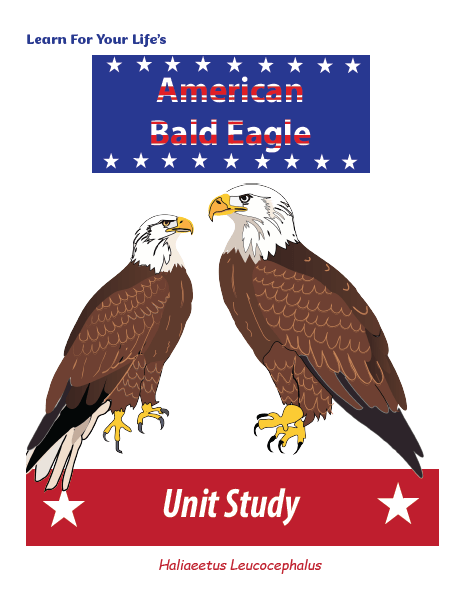
Here is another (and slightly more complicated) taxonomy chart: Halieeatus Leucocephalus - or the bald eagle.
Our American Bald Eagle Unit includes activities that identify the taxonomy chart in greater detail. It's a total of 14 lessons, 3 of which involve the scientific classification and taxonomy.
Make Your Own Chart
Encourage students to develop a taxonomy chart of another animal or plant they are interested in.Use a field guide if you have one. It can be a field guide of birds, fish, flowers, trees, insects or other group. This will help the student visually see the breakdown.
Remind the students that they may run into problems with the classification system as we did with the dogs. Modern zoologists and botanists have discovered and classified many more organisms that have not fit perfectly into the system.
MatchCard Science
How To Use MatchCards
Download the FREE MatchCard Science Instructor's Guide and see how MatchCards can make building their science knowledge base fun.
Zoology Unit Study

There are a total of thirteen zoology objectives and MatchCards for this unit which will take 6 to 8 weeks to complete.
12 Science Unit Studies
Chemistry is only one of twelve complete unit studies for kids in 3rd to 8th grade.
Comprehensive objectives, hands-on projects, suggested science fair experiments, and the fun game-like MatchCards keep them interested in learning science. See all twelve MatchCard Science Unit Studies.
Ready To Use Resources




About Our Site
Hands-On Learning