

Bald Eagle Lessons
"The American Bald Eagle Unit Study is a multi-level unit with 15 educational activities."
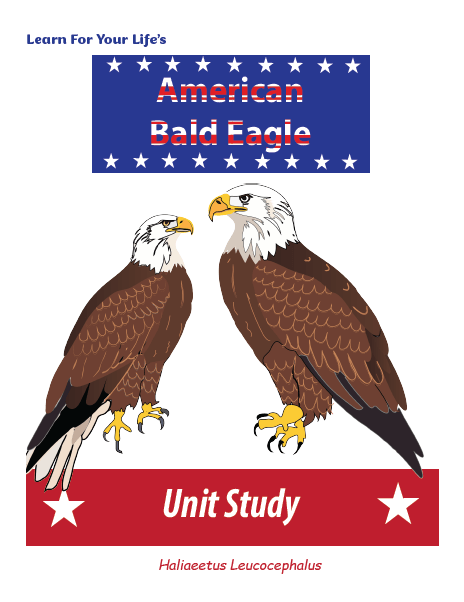
Download the Bald Eagle Unit Study
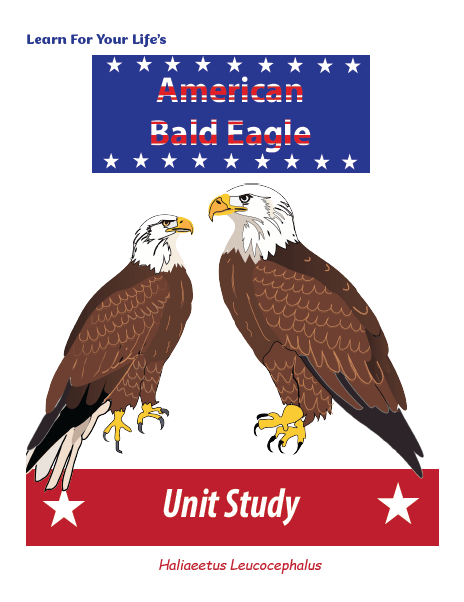
$2.99

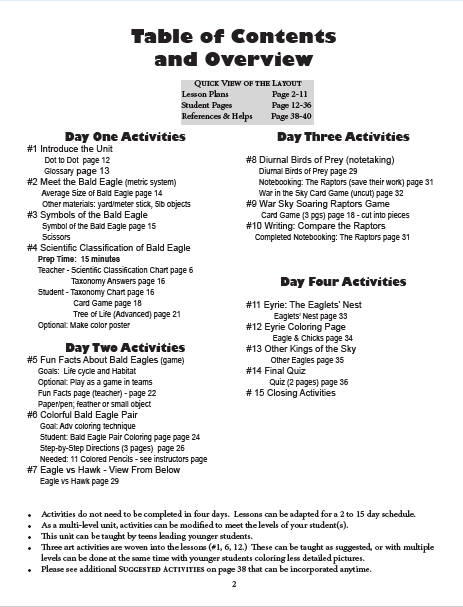
40 Pages - 15 Activities
Teacher's Lesson Plans and Student Activity Pages Included
Size of Eagles
Activity #2
Height of Bald Eagle
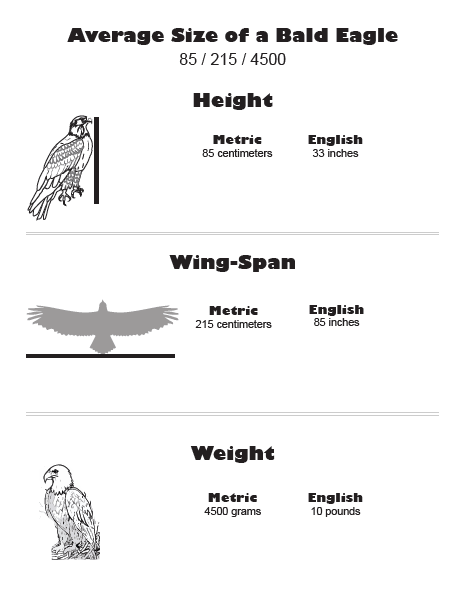
We start with a hands-on activity measuring the average height of a bald eagle. (If you were sitting on the ground and a bald eagle walked up to you, who would be taller?)We also give students practice with the metric system. Compare the height in English and metric.
Bald Eagle Wingspan
From tip to tip do you know how wide the eagle is when flying?The average is 85 cm. Compare that to the height of an average grown man.
Weight
Okay, so if the bald eagle can look you in the eye when you are seated on the ground, and is as long as a grown man is tall when wings are out, how much is this bird going to weigh?4500 grams. About ten pounds.
Some of the big ones get even heavier; the big ones come in at a whopping 6400 grams (14 pounds.)
When it comes to weight, you can basically compare our majestic bald eagle to your Thanksgiving turkey.
Did you know that female bald eagles are larger than their male counterparts? That is true of most birds of prey.
Bald Eagle Dot to Dot
Activity #1
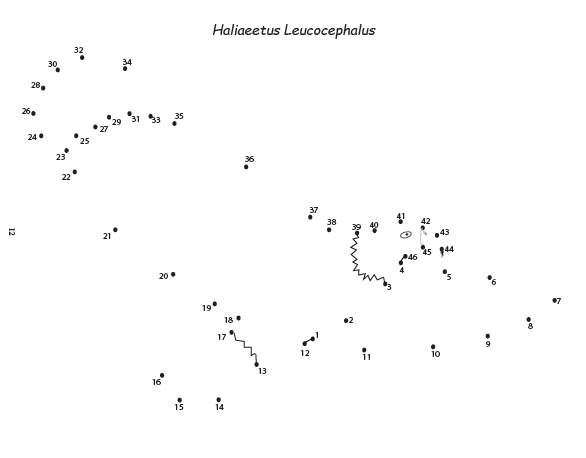
Can they guess what this unit is about before they complete the picture?
Another option: use the dot-to-dot as an art activity for younger students as older students complete the coloring/blending activity below.
Bald Eagle Symbols
Activity #3
The Bald Eagle as a National Symbol
The bald eagle was adopted as the national symbol of the United States of America by the Second Continental Congress on June 20, 1782. It is featured on the Great Seal of the United States with the motto “E Pluribus Unum.” (Out of many, one.)The Bald Eagle as our National Bird
While it has long been the symbol of America, the bald eagle was not officially declared the national bird until 2024. The 118th Congress declared the bald eagle the national bird in a unanimous vote and the law was signed by the President on Christmas Eve. Individual states all had state birds, but now the USA has officially declared its national symbol is also its national bird.Native American Symbol
Before the United States was formed, different native tribes considered the bald eagle sacred. Their feathers were used in headdresses for pow-wows. They were honored for their strength and vitality.Eagle as a Symbol of the Roman Empire
The Roman Empire also used the eagle as a symbol of strength and power. It was probably the golden eagle which is about the same size as the bald eagle. Unlike the bald eagle which is only found in North America, the golden eagle is in Europe and most continents. It was used on Roman banners, flag poles, sculptures, and coins.Student Activities with Eagle Symbolism
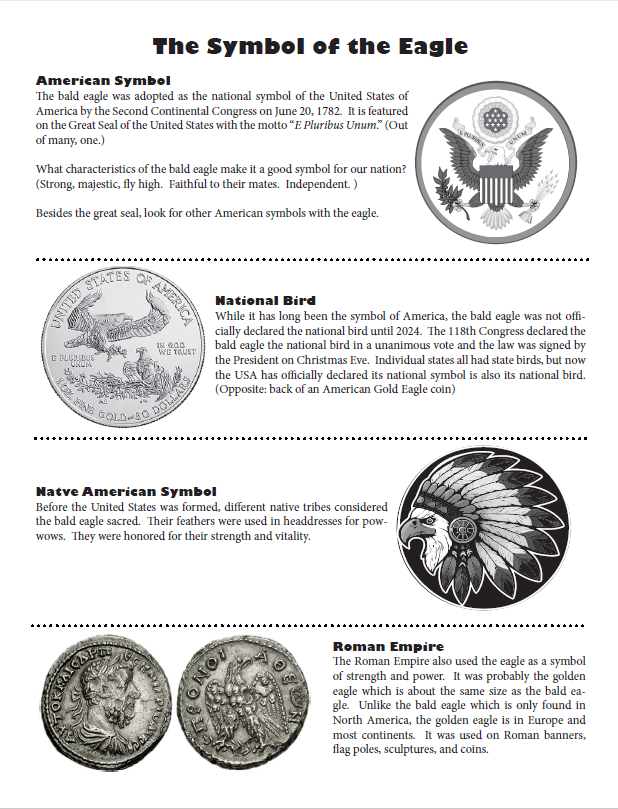
Students can search for American eagle symbols. (Hint: check coins and cash.)
You can even make a contest to see who comes up with the most examples.
Scientific Classification of the Bald Eagle
Activity #4
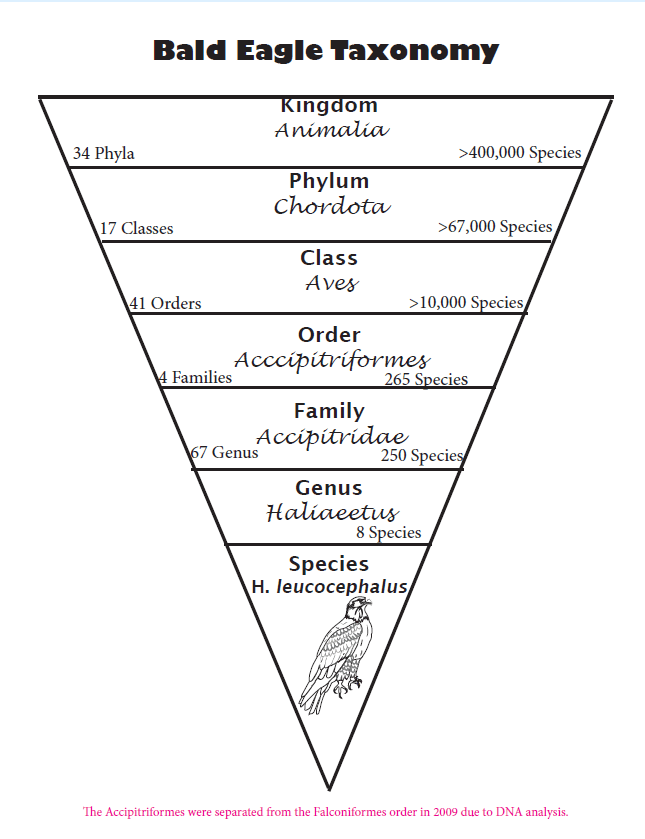
What Is An Eagle, Anyway?
Eagles are diuranal birds of prey in the accipitriformes order.Here is the scientific classification of eagles:
- Domain: Eukarya (multicellular organisms with complex cells with a membrane-bound nucleus)
- Kingdom: Animalia
- Phylum: Chordota (has a spinal cord)
- Class: Aves (birds)
- Order: Accipitriformes (diurnal birds of prey)
- Family: Accipitridae (talons that tear: includes hawks, eagles, kites, buzzards)
- Genus: Haliaeetus (sea eagles) Greek Hali = sea; aetus = taker, hunter, thief
- Species: Leucocephalus (white head) leuco=white; cephalus=head
Bald Eagle Scientific Classification Activity
Card-Selecting, Poster-Making Project
We include a classification activity of selecting cards for each taxonomy level and creating a poster for Haliaeetus leucocephalus.Additional information is provided in charts for teachers and high school students.
Fun Facts: Bald Eagle Life Cycle and Habitat
Activity #5
This activity can be done as a game with pointer questions. If students can answer the stem of the question without the multiple choice answers, they get two points. If they are given the multiple choice answers and they select the correct answer, they get one point.Bald Eagle Life Cycle
Here are the answers to our pointer questions on the bald eagle life cycle:- Typical number of eggs per year: 1-3
- Time for incubation: 35 days
- Age eaglets learn to fly: 12 weeks
- Age at maturity: 5 years
- Lifespan in the wild: 25 years
- Lifespan in captivity: up to 50 years
Bald Eagle Habitat and Habits of the Sea Eagles
- Main food: fish
- Eaglet's diet: dead fish
- Other foods: small mammals and small reptiles
- Flying Speed: 20 to 40 mph
- Diving Speed: 70 to 100 mph
- Range: North America only
Colors of the Eagle
Activity #6 - Art Project
Blending, Layering, Feathering
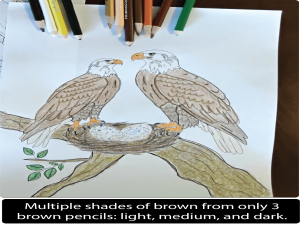
Students of all levels of artistic talent enjoy the art lesson with the bald eagle pair. In this lesson, they will learn blending, layering, and feathering colors.
While any color pencils (or other medium) can be used, we recommend artist quality pencils (like Prismacolor or Faber Castell). Recommended pencil colors include:
- 3 colors of brown (light, medium, dark)
- Metallic gold
- Two colors of green (light, dark)
- Orange
- Yellow
- Black
- White
- Peach or pink
- Light blue
Eagle vs Hawk: View from Below
Activity #7 - Silouette Comparison of Eagle vs Hawk
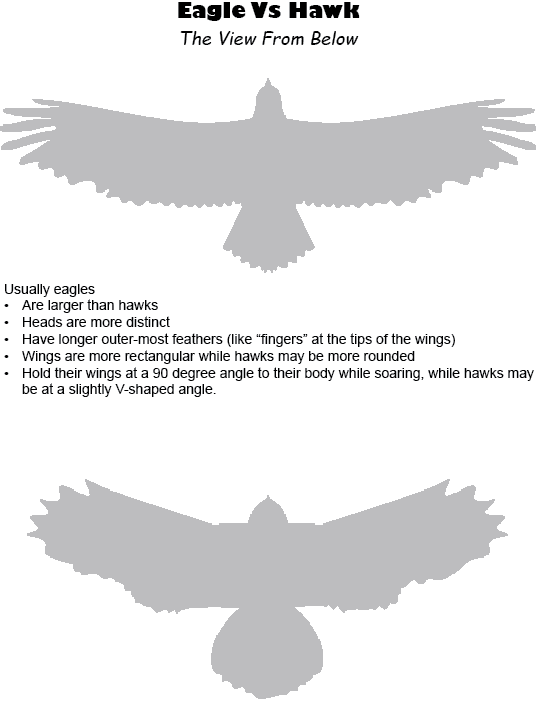
It is hard to detect the actual species from below, and some species of eagles and hawks may be larger and heavier than others. But here are some general points of comparison:
- Eagles are usually larger with a larger wingspan.
- The heads of eagles are most distinct.
- The outer-most wing feathers (like “fingers” at the tips of the wings) are more distinct on eagles.
- Eagle wings are more rectangular while hawks may be more rounded.
- Eagles hold their wings at a 90 degree angle to their body while soaring, while hawks may be at a slightly V-shaped angle.
Diurnal Birds of Prey
Activity #8 - Notebooking
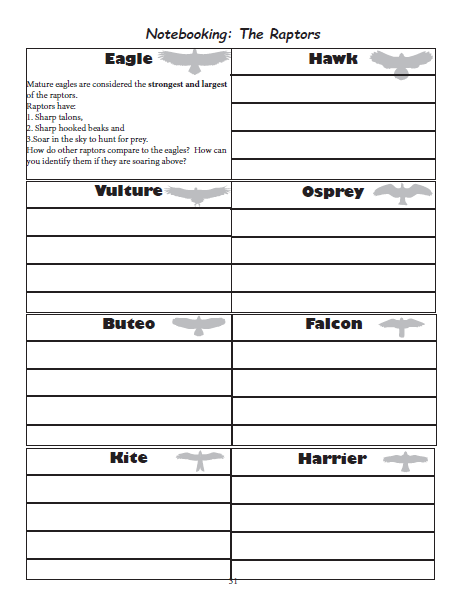
- Hawks
- Vultures
- Ospreys
- Buteos
- Falcons
- Kites
- Harriers
War In the Sky
Activity #9 - Sky-Soaring Raptors
This card game is a spin-off from the old card game "War."Students have sets of cards with the silouettes of eagles, hawks, falcons, buzzards, ospreys, vultures, kites, and harriers.
Flip your card and compare it to your opponent. Which bird would win?
This game gives students a chance to practice metric measuring skills (which is probably not what you expected from a War-based card game.)
Compare the Raptors
Activity #10 - Writing Activity
There are a variety of ways students can write about the raptors, and we provide several suggestions.But here is an activity specific to this activity that will strengthen the skills of our Write On and Grammar Slammer students:
- Note that each description in Activity #8 uses a different pattern of complex sentence.
- Use these different patterns on a different raptor.
- It's a fun and painless way to teach sentence variety.
Eyrie: The Eagles Nest
Activity #11
Learn 6 fun facts about the size, shape, weight, and location of eyries.With this activity we also learn how to pronounce "eyrie," practice a fun-tongue twister, and do a lapbook page illustration.
Eyrie: An Eagle and Eaglets
Activity #12 Coloring Page
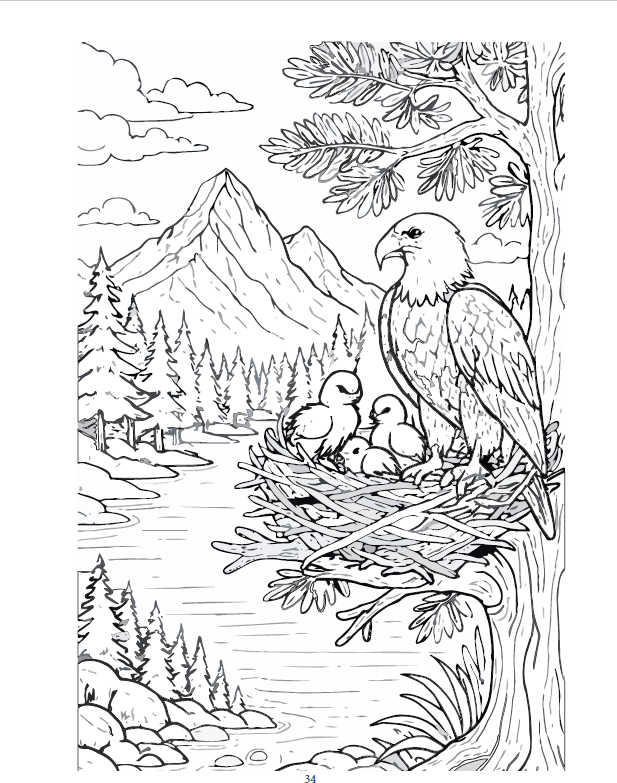
This activity includes the two eaglets and mother and a background mountain scene: plenty of opportunity to blend a multitude of colors.
Other Eagles: the Kings of the Sky
Activity #13 - The Mighty Kings of the Sky
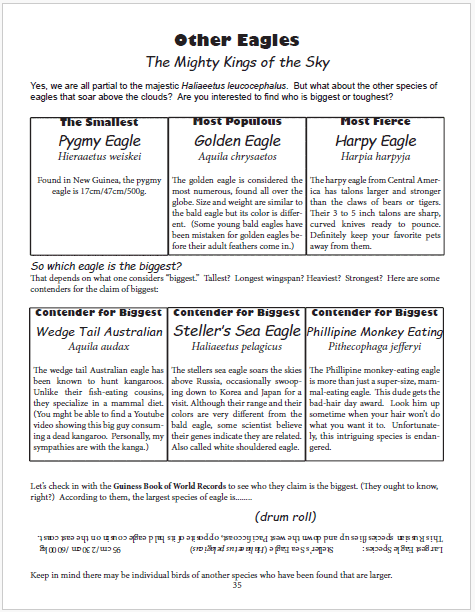
Are you interested to find which is the biggest? The toughest? The heaviest?
Our info sheet provides six other species of eagles to check out:
- The smallest
- The most numerous
- The toughest
- AND three contenders for biggest
Meanwhile, students have a fun internet search looking for some pretty spooky looking eagles.
Final Quiz
Activity #14 - Review Activity
It can be a graded quiz, an open book test, or a group project.Matching, multiple choice, and a crossword puzzle of glossary terms give students the chance to prove what they have learned.
Closing Activities
#15 - Wrap Up
Close the unit by making a unit study book, giving oral presentations, making a bibliography, or completing a unit study points page.Suggested Activities
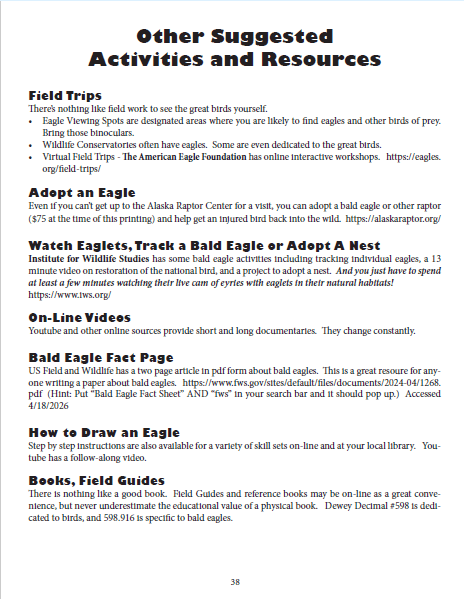
Field trips, field guides, adopt-an-eagle...the possibilities are endless.
We give you seven starting points, and would love to hear all the ideas you do in your bald eagle unit study.
Download the Bald Eagle Unit Study
$2.99
Teacher's Lesson Plans and Student Activity Pages Included - 40 pages
Ready To Use Resources



About Our Site
Hands-On Learning